Lies with short legs and lies with long noses
The Adventures of Pinocchio“Lies with short legs and lies with long noses” is the Talking Cricket’s distinction between two kinds of falsehood, delivered when Pinocchio’s nose has grown after he lies. The expression gives dishonesty a comic, physical measure: what might otherwise remain an abstract moral fault becomes a conspicuous obstacle Pinocchio cannot hide or escape.
The Distinction
The Talking Cricket tells Pinocchio, “There are two kinds of lies, lies with short legs and lies with long noses.” The line classifies lies through contrasting bodily images, then immediately applies the second kind to Pinocchio: “Yours, just now, happen to have long noses.” It is both a rebuke and an explanation of the strange consequence that follows his dishonesty. The phrase’s wit makes the lesson memorable without softening its force: Pinocchio’s own lie has marked him.
A Visible Consequence
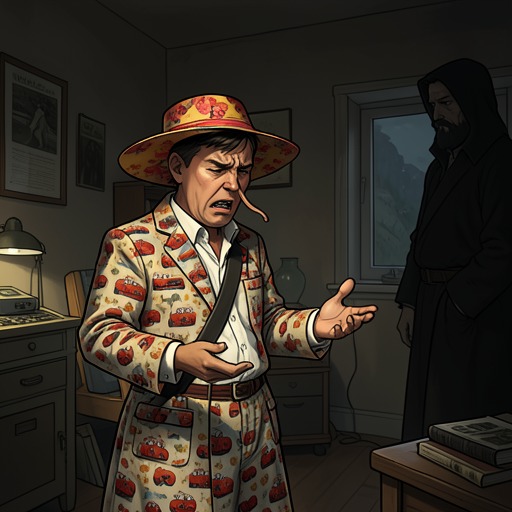
The saying is not left as a metaphor. Ashamed, Pinocchio tries to flee the room, only to discover that his nose has become so long he cannot get it out of the door. The lie’s consequence blocks the very escape his shame prompts. The scene makes concealment impossible through physical comedy: the evidence of his falsehood is attached to him, enlarged, and caught fast in an ordinary doorway.
Warnings and Recognition
The expression belongs to a wider pattern in which Pinocchio resists advice and then meets its consequences. Before falling into the hands of the Assassins, he dismisses the Talking Cricket’s warning and reasons that Assassins are inventions parents use to frighten children who run away at night. His confident denial makes the danger he is about to face more than a surprise; it exposes how readily he treats caution as something to evade.
After a schoolmate is hurt in a fight, Pinocchio stays behind while the other boys flee. As he tries to comfort the boy, he admits that he should have gone to school and listened to warnings about bad company; he also recognizes that he is stubborn and does as he wishes. This is not another instance of the nose saying the truth for him. Instead, Pinocchio speaks directly about his own conduct and its cost, connecting bad choices to real distress.
Storytelling and Moral Address
The book’s moral language is framed as speech to children. At the beginning, the narrator anticipates young readers’ expectation of a king and corrects it: the story begins instead with an ordinary piece of firewood. Later, the narrator again addresses “my dear children,” inviting them to guess what Pinocchio finds before revealing the scene. These direct addresses give the tale a playful, conversational voice; the Talking Cricket’s memorable formula works within that mode, turning a warning into an image readers can recognize and judge for themselves. The long nose is at once a joke, an exposure, and a practical barrier: Pinocchio cannot simply talk his way past what his lie has made visible.